
Literary figures like Charles Dickens have been studied and edited in terms of their own work for more than a century. How did Victorian authors reflect upon the influences of the day, and how has our treatment of them changed over time?
Students from Professor Rae Yan’s Fall 2022 English Literature course on Charles Dickens attempted to answer those questions by posting single items that stood out to them from a selection of Victorian ephemera from the Rare Book Collection. Over the course of two visits, they generated a caption for that item, then worked collaboratively to select their favorites and refine their descriptions into object labels.
The result is a mini exhibition of their work, showing how the work of authors, illustrators, and publishers, who were instrumental in producing these materials for their immediate audience, and the readers and collectors who have used and changed them since. Many thanks to the students for digging into the collections, and for their work in researching and revising the labels for this display!
Please scroll through the sections in order, or use the links to each individual section.
Part I: Newspapers
- “The Murdered Family Near Uxbridge,”
- “Cinderella – Painted by George Cruikshank”
Part II: Songsheets and Ballads
- “A Basket of Onions”
- “The Black Horse”
- “A New Song for the Times”
Part III: Almanacs
- “The Tables Turned at the Zoo”
- “The Death of Richard III”
- “Paterfamilias Tries the Cold Water Cure
Part IV: “Collectible” Dickens
- A Christmas Carol, 1843
- The Cricket on the Hearth, 1846
- Sketches By Boz, 1850
Part I: Newspapers
“The Murdered Family Near Uxbridge”
from the Illustrated London News, June 4, 1870


The Illustrated London News began in 1842 as a conservative-leaning weekly periodical. As the first illustrated newspaper, it reported on sciences, culture, and the British royal family. This selection from June 1870 details the murder of the Marshall family through an engraving of their home and an article on the murders. Sentimental language and homely imagery are used to invoke pathos as the journalist discusses the children’s ages, the family’s good-hearted nature (especially its patriarch’s), and the engraving of the home. The article reflects prejudices against indigenous peoples, as the journalist analogizes the savagery of natives in the Americas and New Zealand in attempts to communicate the grotesqueness of the murders committed – a harmful statement for a science-based newspaper.
Object Label Created by:
Carly Achinapura, Maria Hernandez Rea, Victoria Kevers
“Cinderella – Painted by George Cruikshank”
From the Illustrated London News, July 29, 1854

This engraving is George Cruikshank’s, a renowned British caricaturist, take on the classic fairytale Cinderella. It depicts the young woman in awe as the fairy godmother transforms a pumpkin, mice, and lizards into a carriage led by horses. Cruikshank uses his own caricaturistic style when describing the fairy godmother. He depicts the magical fairy as a small, elderly godmother with a frightening visage. The image’s caption mentions that Cruikshank typically recounts a history of the “follies and street enthusiasms” of 19th century London. The writer comments that Cruikshank’s admirers would be pleased by his illustrations of the fantastical, attributed to his sobriety, rather than his caricatures of London’s socio-political environment.
Object Label Made by:
Veronica Varona, Saloni Patel, Reese Johnson, and Antonio Salgado
Part II: Broadside Ballads & Songsheets
“Basket of Onions”
Printed by T. Pearson, Manchester (c. 1850-1899)
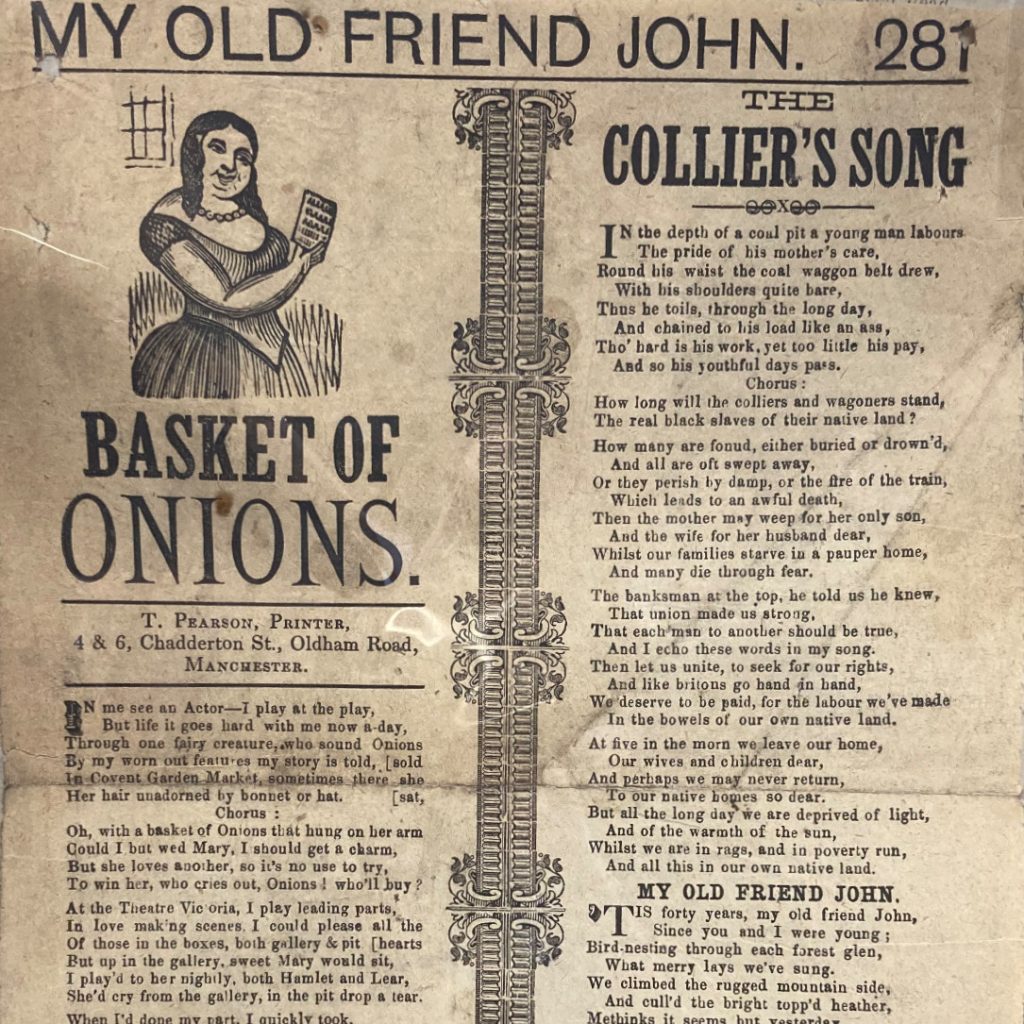
Easily accessible to the working class, song sheets such as this were a penny each. Its value is evident in its creasing and typo, indicating poor paper and printing quality. Holes at the top suggest this page was pinned to the wall. Decorative elements, including an ornate column and the image of a woman, were included to make the sheet more desirable.
The lyrics recount an actor’s love for an onion-seller, who claims they cannot wed because she is poorer than he; he persists regardless. Ultimately, the actor is pelted on stage, lamenting lost love, and the woman marries someone else. This narrative cautions against marriage below one’s socioeconomic class, reinforcing class divisions and revealing social priorities in nineteenth-century England.
Object Label Created by:
Isaac Ahn, Katherine Panagoulias, Amanda Priore
“The Black Horse” (and “The Temperance Band”)
[unknown author, unknown publisher]

The Black Horse ballad is printed alongside The Temperance Band. The sheet is yellow, folded, and has holes suggesting it was pinned. The lyrics of the ballad reveal the resistance of men to enlist. The narrator, Charles Egan, lives as a “prince” exercising liberty. While in Galway, an officer recruits him. Charles is from Armagh, Northern Ireland. The song ends with Charles bidding farewell to his family and girls.
As a ballad of unknown origin, it is likely an Irish song passed through generations. The surname Egan is Irish, Atkinson is English. The ballad and Eagan’s resistance may be due to the political atmosphere. It is indicative of the long and strained relationship between the Irish and English people.
Object Label Created by:
Maria Hernandez Rea, Yasaswini Potluri, and Michael Fontane
“A New Song on the Times”
[unknown author, unknown publisher]

This is a partial broadside song sheet made of thin cheap paper, easily accessible to the lower classes. The ballad validates the deplorable state in which the working class lived, while also recognizing the need for change. The song is eight stanzas and follows a common meter that forms a catchy tune allowing for easy memorization, allowing workers to recall the ballad at worklines and pubs.
The audience is further established by the diction used, ‘o’ is replaced with ‘a’, for example ‘hame’(ln. 7), others are altered so they are hard to comprehend like, “Aud gi’es a’” (ln. 6). Overall, the spelling of words reflects the pronunciation of the targeted audience, for easier comprehension, and allows them to identify with the ballad.
Object Label Created by:
Clara Cajade, Alicia Grove, Amy Nekhaila
Part III: Almanacs and Cartoons
George Du Maurier, “The Tables Turned at The Zoo”
Punch’s Almanack for 1867

George Du Maurier’s “The Tables Turned at the ‘Zoo’” is a satirical cartoon published in Punch Almanac (1867), a British magazine that explored Victorian challenges with humor and satire. This image accentuates concepts of human superiority within zoos.
The roles of humans and animals are reversed, illustrating a variety of wild animals dressed as Victorians while poking, prodding, and staring at their human counterparts trapped in cages. This propounds on the controversies of keeping animals in captivity by using anthropomorphism and dehumanization.
The London Zoological Society was founded 40 years earlier, demonstrating the increasingly prevalent discourse of animal rights.
Object Label Created by:
Jillian Colosimo, Elizabeth De Solo, and Benjamin Li
Thomas Nast, “The Death of Richard III and the Birth of Napoleon Bonaparte”
Nast’s Illustrated Almanac for 1871
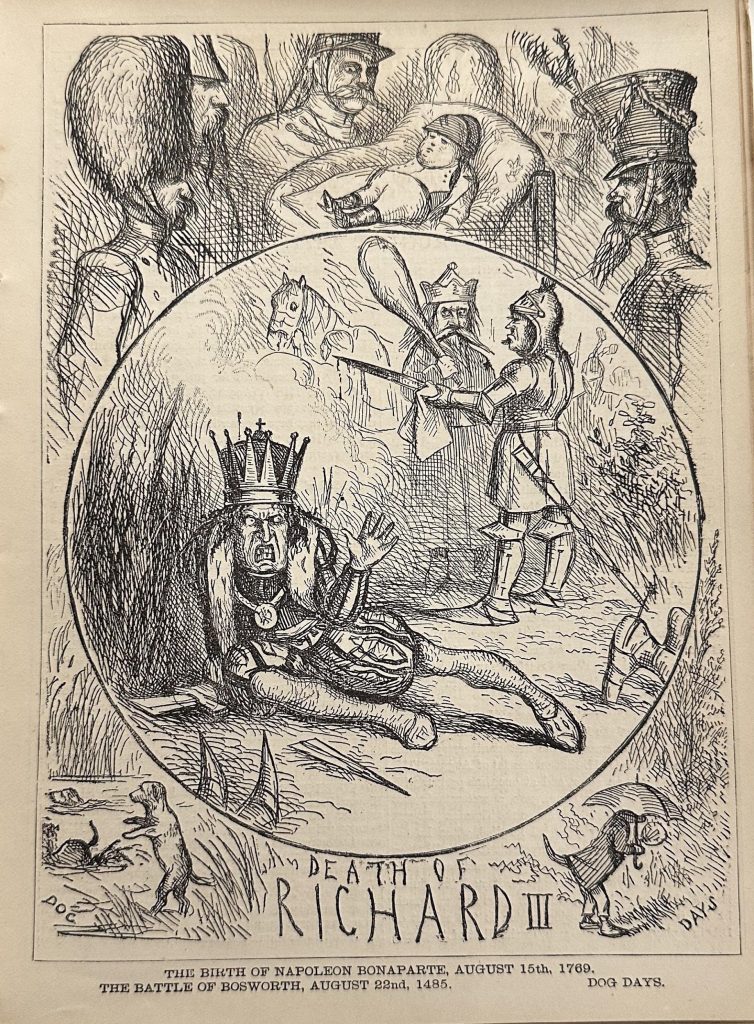
Thomas Nast (1840-1902) was an American caricaturist famous for his political cartoons during the Civil War and Reconstruction. Nast’s Illustrated Almanac, published between 1871-75, introduced a (short lived) critical twist on the standard almanac through the use of caricatures, cartoons, and comics.
Nast included cartoons illustrating significant historical events for each month, with this image representing August. The central image depicts King Richard III’s defeat at the Battle of Bosworth Field in 1485, marking the rise of Tudor monarchs. It also celebrates Napoleon’s birth in 1769, while foreshadowing his future as a revolutionary miltiant leader with soldiers. Below, the dogs allude to the phrase the “dog days of summer”. True to Nast’s style, his drawings poke fun at these events–from baby Napoleon’s clothes to King Richard III’s facial expression and body language.
Object Label Created by:
Isa Motola, Clare Lucian, and Rikki Baynard
John Leech, “Paterfamilias Tries the Cold Water Cure in a case of Organ-Grinding”
Punch’s Almanack for 1858

John Leech, an esteemed artist specializing in social caricature, created humorous woodcut illustrations depicting urban London urbanity featured in the yearly publication of Punch’s Almanack. Enjoyed by the English middle class, Punch offered social commentary through illustrations, jokes, and facts.
John Leech’s illustration in Punch’s Almanack for 1858 depicts a man spraying a disheveled organ-player from a water pump. This illustration is accompanied with the description, “Paterfamilias tries the cold water cure in a case of organ-grinding.” In Victorian society, organ-grinders were looked down upon as they were often immigrants and seen as beggars. The paterfamilias, or the male head of household, drenches the street musician while the sons inside the house follow suit, perpetuating the hatred of organ-grinders.
Object Label created by:
Grace Mercurio, Sadie Wiliams, and Olivia Giovenco
Part IV: “Collectible” Dickens
A Christmas Carol
London: Chapman & Hall, 1843

The edition of A Christmas Carol shown in our collection demonstrates the prestige it had among Dickens’ other works. Having been published first in a gift series, the publishers intended for it to attract the public eye. Every illustration is beautifully colorized, making it unique among its black and white counterparts. The cover was once the same vibrant red as the rest of the series, however, having been read and handled so often it has caused the color to fade.
Object Label Created by:
Bryce MacKay and Ryan Knutson
The Cricket on the Hearth
London: Chapman & Hall, 1845

The Cricket on the Hearth was an eerie Christmas story written by Charles Dickens, popularly sold in a holiday set. In harsher climates like London, the winter season saw greatly increased illness and death. This reality led many authors to experiment with death, the afterlife, and related fantastical elements. Components of terror in Dickens’ thrillers engaged his upper-class readers and contributed to a sense of the “sublime,” enabling audiences to relish the “appalling” for its stark contrast with their reality. In the example above, an illustration of a comfortable domestic scene crawls with winged creatures, rural greenery, and an ominous clock tower. Here, themes of time, afterlife, and tradition combine to form the thrilling genre which prospered within seasonal conditions.
Object Label Created by:
Claire Sabino, Kiki Shaffner, and Madison Engler
Sketches by Boz: Illustrative of Every-Day Life and Every-Day People
London: Chapman & Hall, 1850

Sketches by Boz, is one of Dickens’s earliest works, containing a series of short pieces paired with illustrations by George Cruikshank. Ranging from child workers to prison inmates, these pieces explored London’s people of all classes and struggles by describing their daily lives and providing social criticism. This “cheap” edition, published in 1850, was part of the first re-issue of Dickens’ collected works. It remains in its original binding of stamped green cloth with a gilt spine and applied gold leaf. Despite the price, the book is displayed with a book box commissioned by a nineteenth- or twentieth-century consumer as a decorative piece made to mimic a quarter-leather binding with gold leaf applied.
Object Label Created by:
Serenity Greenfield, Jessica Mordan, Aidan Burnham, and Amanda Priore
