Applications are now open for next Spring’s cohort of Discovery Fellows in Special Collections. Our fellows work closely with mentors in the libraries to turn their interest into a research question or project that they can pursue and receive a $500 stipend upon completion of the fellowship. Our previous fellows have worked across our collections of books, archives, and small, ephemeral publications.
Join us on Wednesday, October 6th, 2026, at 3:30 PM in Smathers Room 100 or on Zoom for an information session to learn more about the Discovery Fellowship and to talk over questions about the application process. For those attending in person, we should also be able to discuss how your interests might be found in the collections.
If you can’t attend the information session, please feel free to contact Bridget Bihm-Manuel (bmbm@ufl.edu) or Betsy Bemis (ehbemis@ufl.edu) with questions about the fellowship. Applications are due by October 28th, 2026, at 5:00PM.
Applications are now open for next Spring’s cohort of Discovery Fellows in Special Collections. Our fellows work closely with mentors in the libraries to turn their interest into a research question or project that they can pursue and receive a $500 stipend upon completion of the fellowship. Our previous fellows have worked across our collections of books, archives, and small, ephemeral publications.
Join us on Wednesday, October 8th, at 3:30 PM in Smathers Room 100 or on Zoom for an information session to learn more about the Discovery Fellowship and to talk over questions about the application process. For those attending in person, we should also be able to discuss how your interests might be found in the collections.
If you can’t attend the information session, please feel free to contact Bridget Bihm-Manuel (bmbm@ufl.edu) or Betsy Bemis (ehbemis@ufl.edu) with questions about the fellowship. Applications are due by November 3rd at 5:00PM.
Congratulations to Aron Ali-McClory, former Discovery Fellow and Askew Scholar! Aron presented their research on UF student protest movements on Wednesday, April 2nd, in Smathers Library. Their presentation included a discussion on the power of student action, the lessons of past movements, and the role of young organizers in shaping the future.
This post comes to us from Discovery Fellow Christian Harris
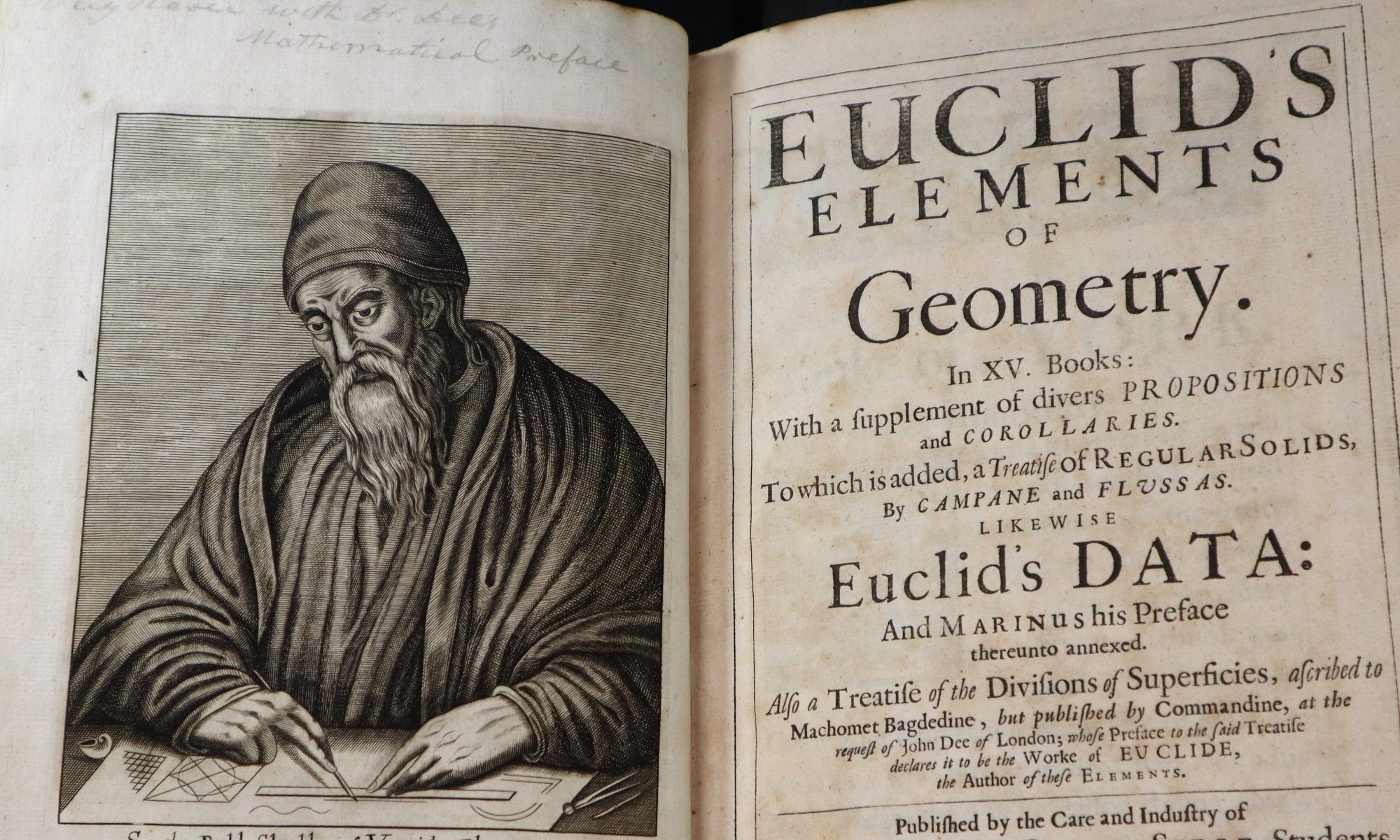
Around 300 B.C.E., a man named Euclid worked and taught at the Library of Alexandria. While almost nothing more is known about Euclid himself, his name spread far and wide as the author of a series of books which became known as “The Elements.” These books provided formal proofs which laid the ground for teaching modern mathematics. While we do not have the completed work of Euclid, the majority of the Elements still live through various historical prints. Most prints of Euclid take on very small changes, such as translations, adapting syntax, or an addition of commentary. Since 1482, it has become standard to print Euclid with illustrations of the proofs as well.
I was able to view copies of Euclid from the 1600s through the 1800s, many intended for school or college use. These editions, and many others, are relatively smaller with only small differences between. While some variations of Euclid have been more eclectic (more on that below), history has not favored those who stray too far from Euclid’s traditional format.
While we have been able to use Euclid throughout history to teach math, there are still practical contributions that have not yet been explored or realized. At the beginning of my research experience, I used various editions of Euclid’s Elements to learn more about one such famous problem, called the Perfect Cuboid Problem.
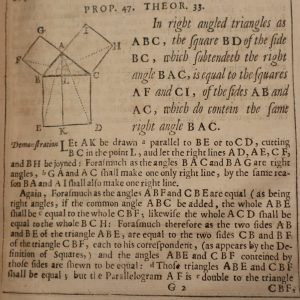
The Perfect Cuboid Problem simply asks if there exists a cuboid (a rectangular prism) such that each side can be divided into two “Pythagorean triple” triangles. A Pythagorean triple is a set of three integers such that the sum of the squares of two integers is equal to the third integer squared (e.g., 3, 4, and 5 are a Pythagorean triple because 32+42=52).
Once you understand what the question asks, it feels almost intuitive that it is impossible for such a cuboid to exist.
However, while no has ever found an example of a “perfect cuboid,” no one has been able to prove it is impossible either. In my research so far, I observed various proofs of the Pythagorean Theorem, attempting to use such information to gain any insight into the Perfect Cuboid Problem.
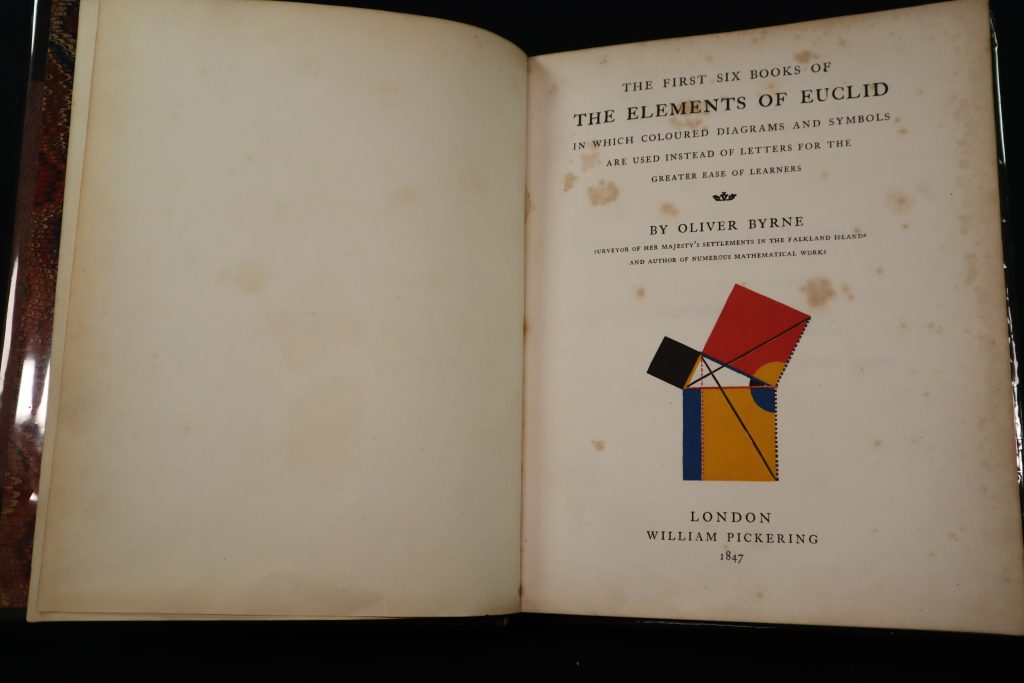
The title page of Oliver Byrne’s “First Six Books of the Elements of Euclid”
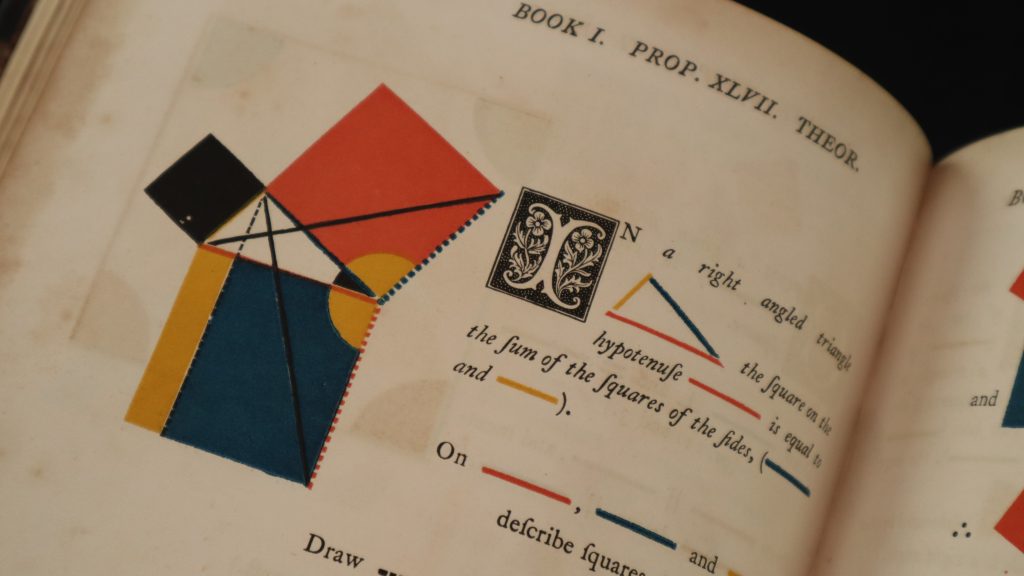
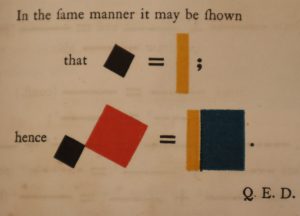
While maneuvering through different variations of the Elements, I spent a lot of time with one of the most unconventional editions ever produced: Oliver Byrne’s “The First Six Books of the Elements of Euclid: In which Coloured Diagrams and Symbols are Used Instead of Letters for the Greater Ease of Learners,” (1847). This edition does exactly as the title claims, rewriting the first six books of the Elements in a completely different format, using color and diagrams instead of words to convey its proofs.
The Pythagorean Theorem illustrated in Oliver Byrne’s Elements (1847)
While this book was not well received at its time of release, it has received a lot of contemporary praise for its progressive nature and efforts to improve comprehension. As I have continued to work with this book, my research has shifted towards its failure at the time of its release, and the steady influence it had on future math education. As contemporary research promotes the use of diagrams and visuals in geometry education, it seems that Byrne had a level of impact on modern education. I wish to now explore what level of influence, if any, that Byrne had on math literature and education, and when this influence began to show.
We’re excited to have three new faces around the collections this semester, working on some very different projects. They’ll be posting more about how their research is going in the near future, but here are some early directions they’re headed in.
Arianna Zhai (’24) is interested in following the ways that different people share knowledge and tell stories in the collections. She’ll be investigating the ways that medical knowledge and ideas about public health evolved in 19th century America and Florida, with the help of our Florida History Collections.
Hannah Whitaker (’21) is an English major with a focus in American and British Literature. With this fellowship, she is finally living out her dream of becoming Matilda, and she hopes that her magical powers will manifest themselves soon. In the meantime, she’ll be exploring nineteenth-century newspapers, pamphlets, and wood engravings. Hannah loves autumn, local coffee shops, children, and her cat, Hemingway.
Stepheny Pham (’22) is a Zoology major who is looking forward to applying her interests in animals and digital storytelling to some of the global materials on natural history in the Rare Book Collection. She will be looking at the different ways that humans relate to animals across time and place, as well as their many social and cultural values.
We’re glad they’re here, and as they work through their projects this semester, we know you’ll agree. Congratulations to Hannah, Arianna, and Stepheny, and thanks to all those who made the start of this program possible!
“Little Red Cap,” illustrated in a 1933 edition of Grimm’s Fairy Tales
My name is Megan Wilson and I am a senior English Major at UF! I come from a really small town in southern Illinois, but UF has definitely become my home away from home. When I am not studying or working, I love spending time with my foster dogs, reading any Stephen King book I can find, drinking coffee, and watching Dance Moms.
After I graduate, I hope to go to law school and then advocate in the courtroom for the various environmental issues that our planet faces today. While my interests are broad, the one thing I appreciate most about researching with the University Scholars Program in Special Collections is the opportunity to pick any topic that you want for your research project. This freedom alleviates some of the pressure and makes the research that much more enjoyable because it is something that you want to be researching. Initially, it was difficult for me to choose because there are so many different avenues to go down, especially in the extensive archival collection that UF has. Ultimately, however, I chose fairy tales.
Early fairy tales are interesting to me because of the strange underlying messages that accompany them.
The stories, although they may seem happy, are often much more sinister if you look closely enough. There is an uncanniness in them, whether it be in the protagonists, the settings, or both. I find the uncanny to be a fascinating way to look at shifting attitudes towards children and the supernatural, and fairy tales tend to have this plurality of themes and genres within them.
An early Gothic parody of “Mother Goose:” Tales of Terror (1801)
We’re thrilled to announce that we are taking applications for our first cohort of Discovery Fellowships in Special Collections. Applications are due Monday, November 30, 2020, for fellowships beginning Spring of 2021
Initiated through the generosity of Joseph and Rebecca White, Discovery Fellowships will provide students them with the assistance and mentoring necessary to bring new life to the collections through their research or creative projects. Over the Spring semester, Discovery Fellows will work with the curators of Special & Area Studies collections to identify and explore materials in the collections at UF.
Fellows will will have the opportunity to share their project with the university community through presentation, exhibition, or other means, and their work will be featured on the Storied Books project. They will receive a $500 stipend at the completion of their fellowship.