This post comes to us from Discovery Fellow Christian Harris
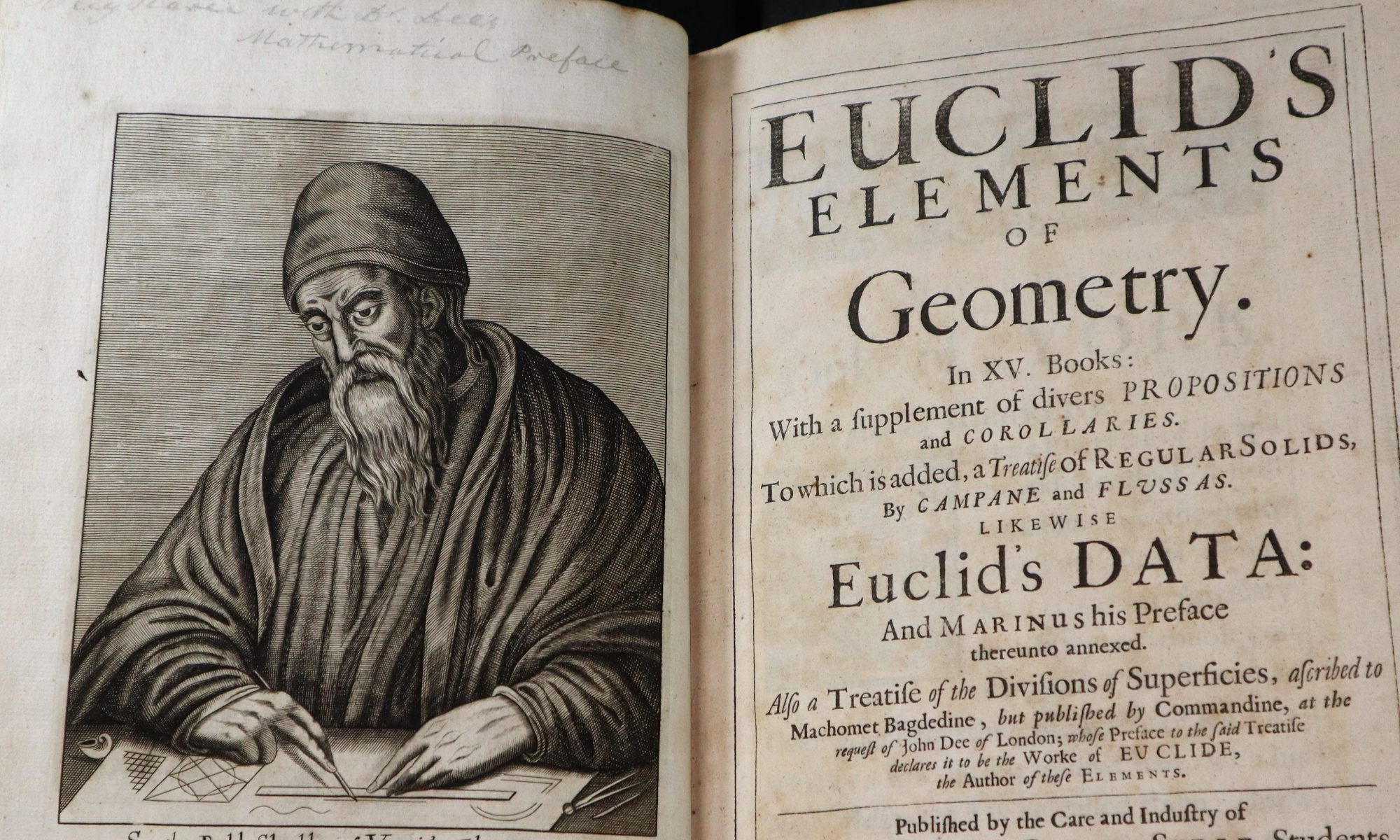
Around 300 B.C.E., a man named Euclid worked and taught at the Library of Alexandria. While almost nothing more is known about Euclid himself, his name spread far and wide as the author of a series of books which became known as “The Elements.” These books provided formal proofs which laid the ground for teaching modern mathematics. While we do not have the completed work of Euclid, the majority of the Elements still live through various historical prints. Most prints of Euclid take on very small changes, such as translations, adapting syntax, or an addition of commentary. Since 1482, it has become standard to print Euclid with illustrations of the proofs as well.
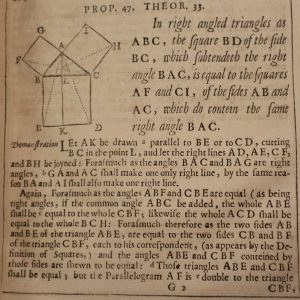
I was able to view copies of Euclid from the 1600s through the 1800s, many intended for school or college use. These editions, and many others, are relatively smaller with only small differences between. While some variations of Euclid have been more eclectic (more on that below), history has not favored those who stray too far from Euclid’s traditional format.
While we have been able to use Euclid throughout history to teach math, there are still practical contributions that have not yet been explored or realized. At the beginning of my research experience, I used various editions of Euclid’s Elements to learn more about one such famous problem, called the Perfect Cuboid Problem.
The Perfect Cuboid Problem simply asks if there exists a cuboid (a rectangular prism) such that each side can be divided into two “Pythagorean triple” triangles. A Pythagorean triple is a set of three integers such that the sum of the squares of two integers is equal to the third integer squared (e.g., 3, 4, and 5 are a Pythagorean triple because 32+42=52).
Once you understand what the question asks, it feels almost intuitive that it is impossible for such a cuboid to exist.

However, while no has ever found an example of a “perfect cuboid,” no one has been able to prove it is impossible either. In my research so far, I observed various proofs of the Pythagorean Theorem, attempting to use such information to gain any insight into the Perfect Cuboid Problem.
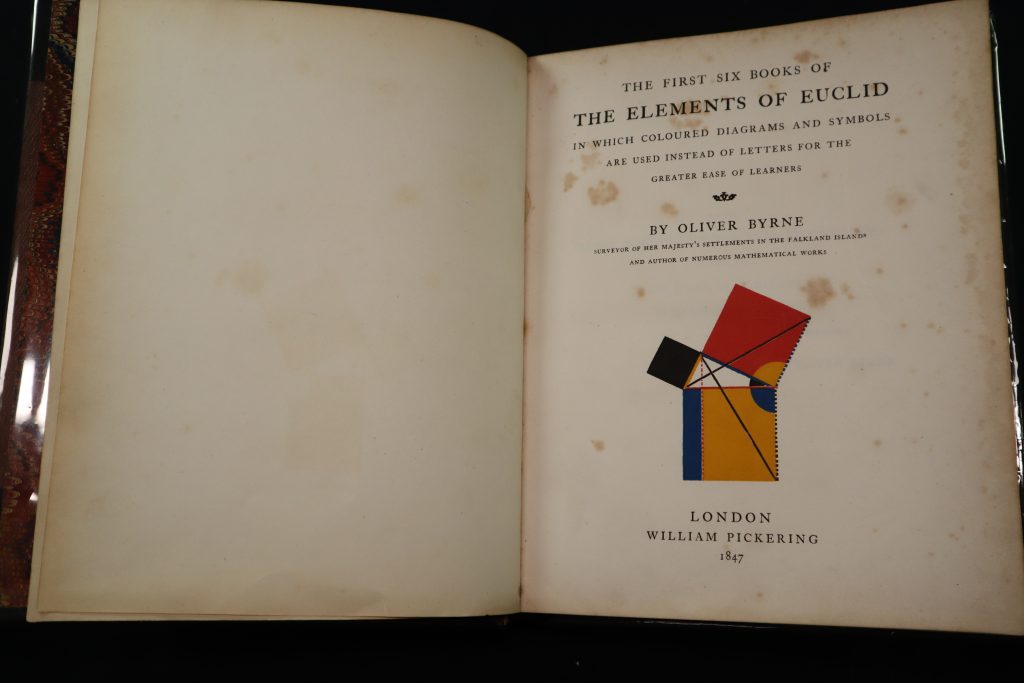
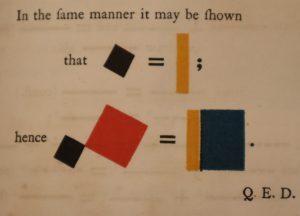
While maneuvering through different variations of the Elements, I spent a lot of time with one of the most unconventional editions ever produced: Oliver Byrne’s “The First Six Books of the Elements of Euclid: In which Coloured Diagrams and Symbols are Used Instead of Letters for the Greater Ease of Learners,” (1847). This edition does exactly as the title claims, rewriting the first six books of the Elements in a completely different format, using color and diagrams instead of words to convey its proofs.
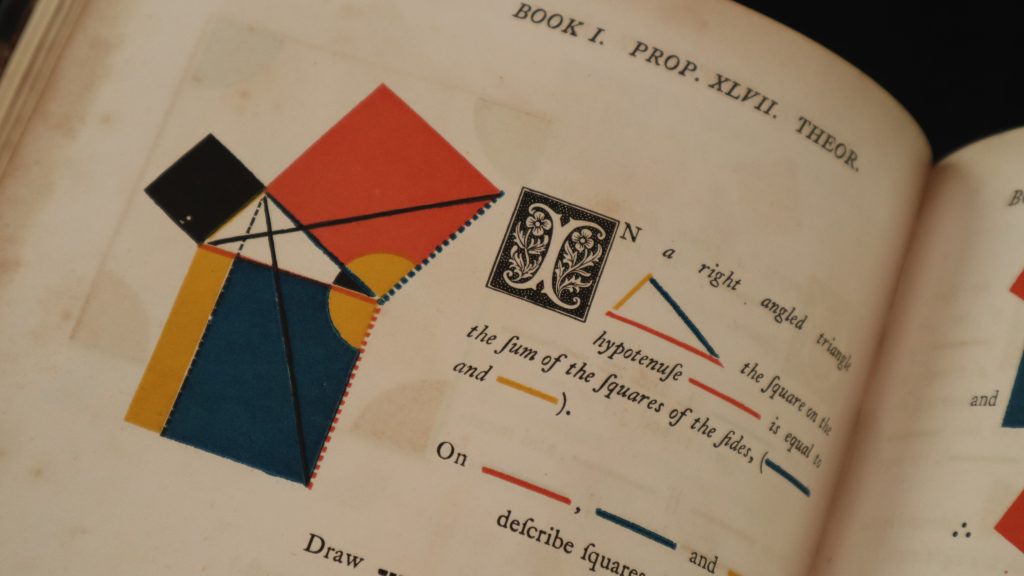
While this book was not well received at its time of release, it has received a lot of contemporary praise for its progressive nature and efforts to improve comprehension. As I have continued to work with this book, my research has shifted towards its failure at the time of its release, and the steady influence it had on future math education. As contemporary research promotes the use of diagrams and visuals in geometry education, it seems that Byrne had a level of impact on modern education. I wish to now explore what level of influence, if any, that Byrne had on math literature and education, and when this influence began to show.