This post comes from Discovery Fellow Christian Harris

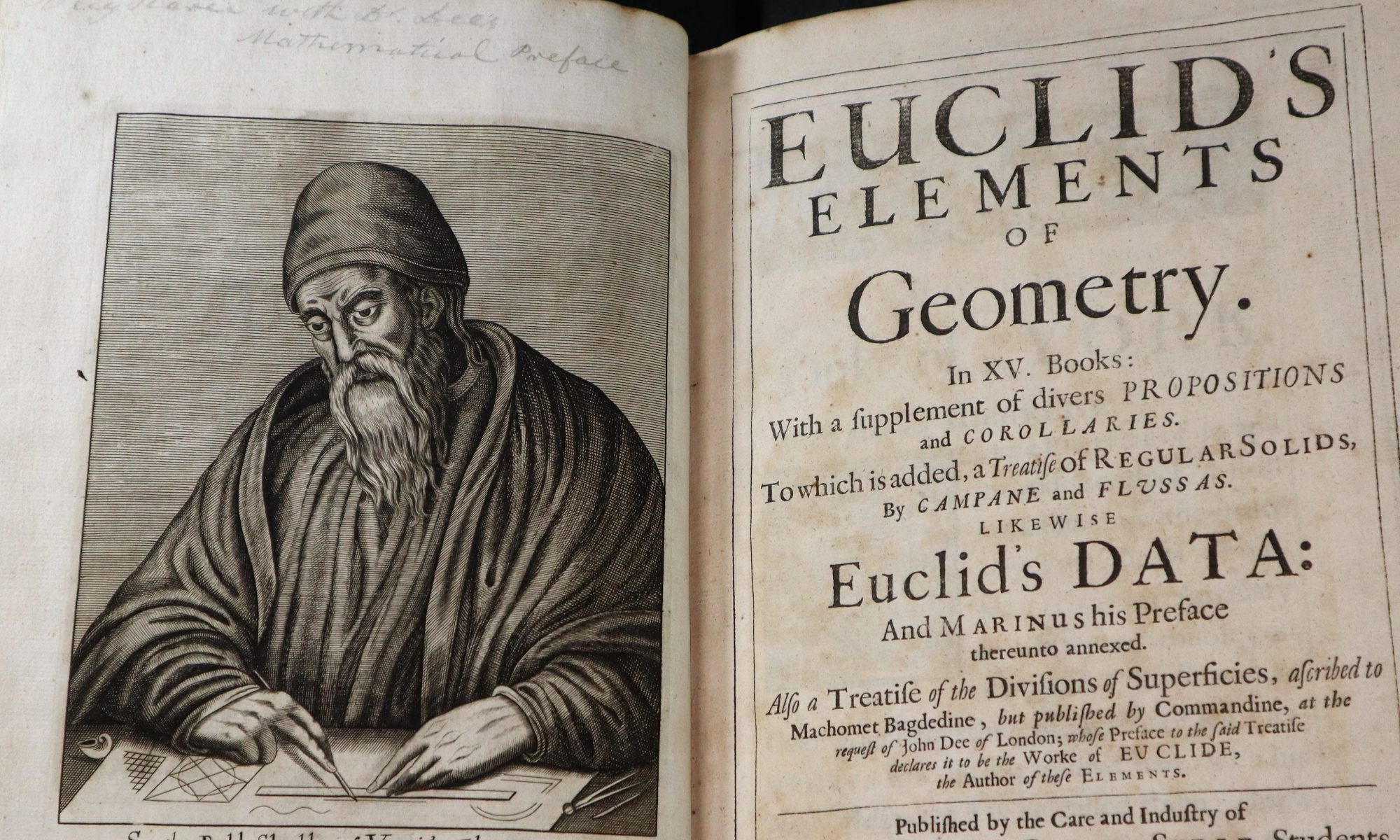
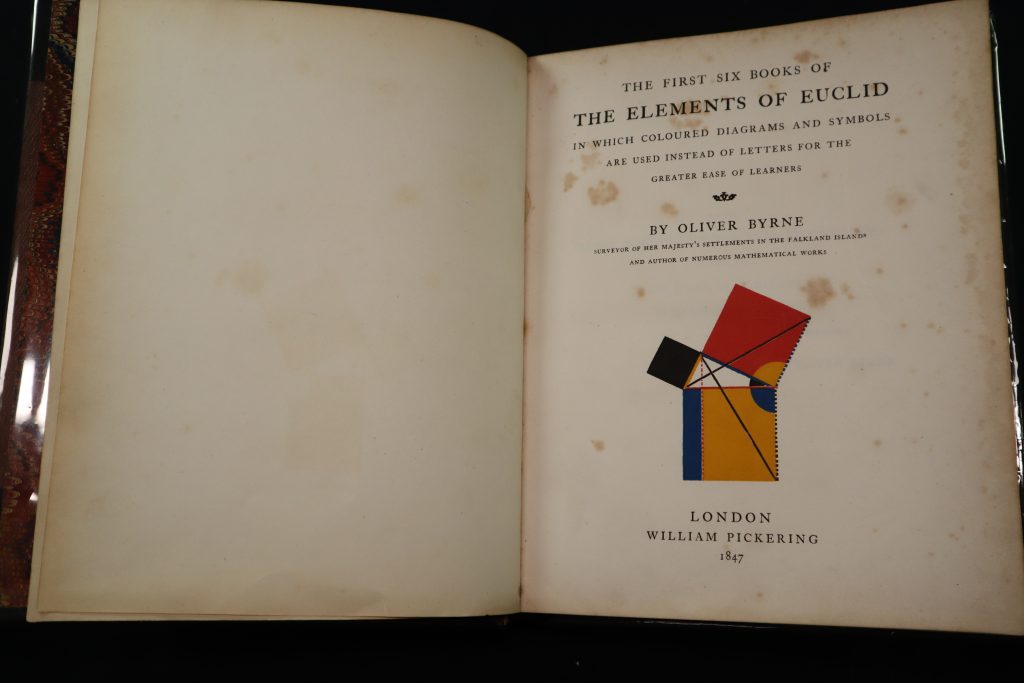
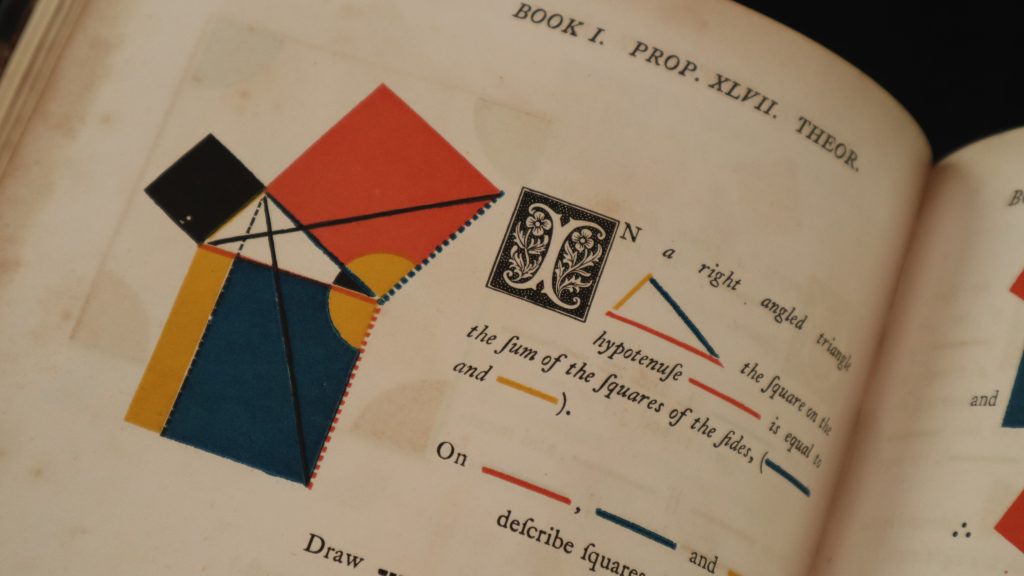
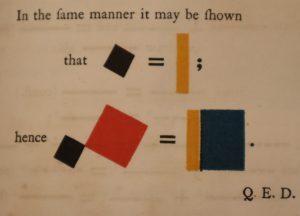
Figure 1: Byrne’s Elements of Euclid
In continuation of my research, I first observed current trends in Geometry education. While understanding that visual stimulus is appreciated in modern math education, I wanted to look at specific findings surrounding the use of diagrams, such as Byrne’s Elements. Overall, it seems that diagrams are becoming an increasingly popular tool for math education. As programming and digital tools have developed, our ability to visually demonstrate “difficult” math concepts has increased dramatically since Byrne’s writing. These visual tools can help increase math comprehension, especially in young learners. As well, visual modeling, and a slight stray from Euclidian based proofs, have contributed to the growth of other forms of math (such as Hyperbolic and Spherical geometry). However, it has also been shown that visual components can have no impact on exam performance, and if a student is not experienced with specific forms of visual media, that media can actually become a hindrance to student comprehension. Overall, visual media has become a near-necessary aspect of math education, boosting student comprehension. However, this is given that the student has been allowed to understand and gain experience with the formatting of the visual media.

Figure 2: Use of 3D modeling techniques in 7th grade advanced math textbook (Burger et. al, 2015)
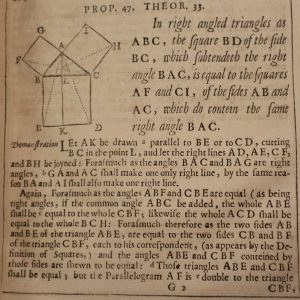
These findings are quite evident when observing geometry textbooks throughout different levels of education. For students who are younger or have little experience with geometric concepts, Euclidean proofs are not presented. Instead, there are findings, absent of proofs, followed by computation and many visual components to help students understand what exactly they are reading. If proofs are presented, they do not reflect the Euclidean style, but are instead simplified and backed by visual/ computational components. However, once you reach college level Geometry (where a student is expected to have experience with geometric concepts), textbooks still reflect pure Euclidean-styled proofs. In many ways, college level geometry textbooks reflect Euclid’s Elements, with minimal edits to diction, syntax, and classifications. Of course, there is variance in textbook content dependent on the publisher, different levels of government, and the standards of each university, so these results are generalized to an extent.

Figure 3: Standard proof from college level Geometry textbook (Venema, 2012)
While post-secondary geometry education has remained largely unchanged, it seems that the use of visual media (such as colors, diagrams, etc.) has flourished in middle/ high school geometry education. What does this say about Byrne? Well, there are many different possibilities for how these changes to education came to fruition. Perhaps it is due to Byrne, who argued that his work was revolutionary (and was later praised by education research). Possibly, changes in legislation surrounding public education enforced changes in curriculum. As well, it could be due to advancements in education research, which prompts change in academic textbooks. More probable, these changes are due to an amalgamation of different trends, both in math education and academia. While I was not able to uncover the direct influence of the implementation of visual media in geometry education, I believe a future path for this research is clear. To continue this research, one would have to specify the causes of changes to U.S. geometry education, specifically looking at how visual media worked its way into middle/ high school curriculum.
Sadly, it is improbable that Byrne is solely responsible for changes to geometry education. However, it is incredible to think that Byrne’s Elements, despite its failure, offered a new perspective into geometry education. The book reformulated the rigid, yet beloved Euclid and showed mathematicians that adaptation is not only possible, but beneficial in cases.

Figure 4: Colors used in 6th grade advanced math textbook (Burger et. al, 2015)